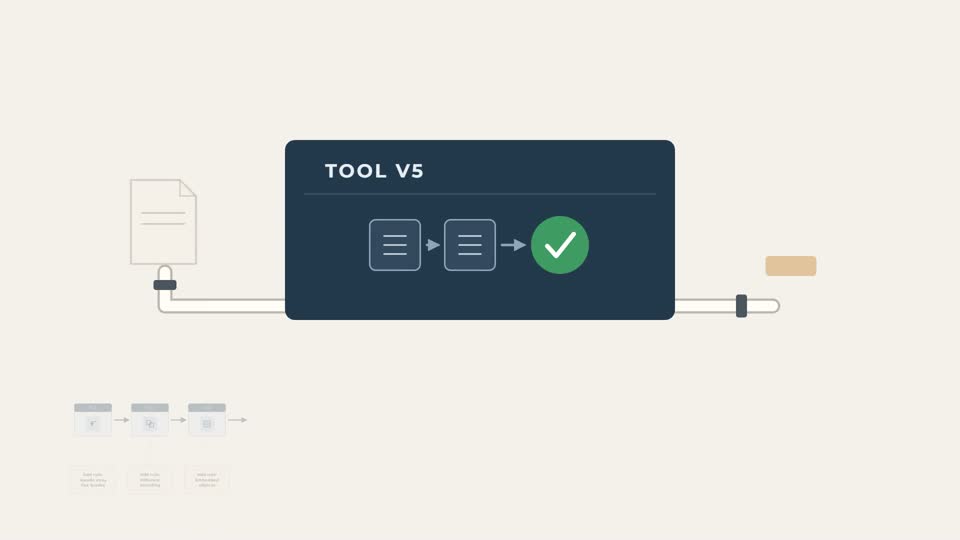
From the job to the screen.
Every piece of work here moves through the same six steps, in the same order, and each step has a rule that does not bend. The rules are the part that took the longest to learn.
Plenty of requests that arrive as “we need a course” are something else once the job has been watched. Saying so is part of the work.
The request always arrives the same way. Somebody needs training on something, and could it be ready by the end of the quarter. What they are describing is the symptom. The problem underneath has to be pinned down from more than one direction before anything gets built: what customers are actually complaining about, how long the task takes a person who does it every day, how often it goes wrong and where. No single source is trusted on its own, because nobody describes their own job accurately and the person asking for the training is usually the furthest from it.
Put those three next to each other and the problem is almost never what it was called. It is a form nobody can find, a step everybody skips, a procedure written for a machine that was replaced two years ago. Sometimes the answer really is a course. More often it is a checklist, a job aid, a fix to the process, or a tool that takes the manual work off somebody’s desk. When it is a course, a pass has to mean the person made the right call under the condition they will actually face, not that they recognised the right answer on a screen.
- Three sources. Complaints, time on task, error rate. Then watch the job to confirm it.
- A pass is a decision. Condition, an action somebody can watch, a standard. If the exam can be passed without making a call, it is measuring recall and calling it competence.
- Time it both ways. The old way gets run one last time with a stopwatch before the new way ships. That number is the whole business case. Estimates do not survive a budget meeting.
- A person stays in the loop. Anywhere a tool makes a silent choice, a human sees the draft first. In regulated work the review gate is the product, not a step bolted onto it.
- It runs where the learner stands. Locked-down laptop, no admin rights, nothing leaving the network. A course or a tool that needs an IT ticket to open is one nobody opens.
Complaints, time on task, error rate. Where the three agree is the problem. Then watch the job to confirm it.
Write what a pass looks like before anything is built.
The experience that produces the decision, and the tools that take the production work off the desk.
Walk the draft with someone who does the job. Score every decision item.
On the locked-down laptop, with no admin rights and nothing leaving the network.
Score the live exam. Time the old way one last time.
From problem to tool
What happens between a task that keeps coming around and a tool that takes it off the desk. Five steps, in order, with the research on where AI-assisted building actually saves time and where it costs it. One film, 3:39.
Watch it →