Every objective in it started with identify or outline.
The mandatory safety qualification for field service engineers at a medical device manufacturer. Lethal current, ionizing radiation, stored energy, chemicals in hospitals. Nobody who passed it had ever been asked to make a decision.
A qualification that could not tell a safe technician from a careful reader.
A performance objective needs three things. The condition you are in, an action somebody can watch you do, and the standard it has to meet. All five opened with identify or outline, and not one named a condition.
Nothing asked for execution, so nobody taking it ever made a safety decision. Rewriting the verbs would not have fixed that. The objectives were an accurate description of a course that certifies you were shown some information, and the qualification exists to certify something else.
An action you can watch
A standard to meet All five: identify or outline
So I scored the live exam.
Arguing from objectives gets you a conversation about what somebody intended, and you lose it. Twelve questions, pass mark seventy percent.
Two screens. Same facts, same five minutes.
Built from scratch for this page, in a different hazard domain. The first asks whether you read the table. The second puts you in a service call where somebody qualified has already isolated the circuit, his lock is on the breaker, and the line has been down two hours.
Pick the answer that sounds right and find out what it costs. Three of the four options contain true statements about lockout. The one most people choose is the one a recall exam would have marked correct.
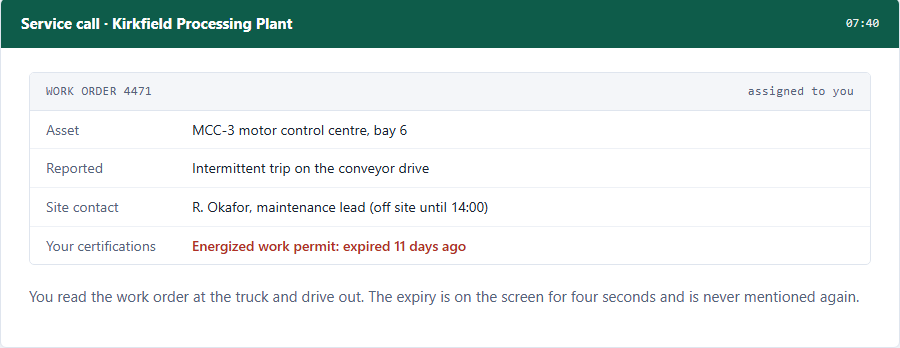 The after. Read the last line.
Two ways to say what is wrong. Only one gets funded.
Identify sits at the bottom
Remember and understand, where identify and outline live. Deciding under conditions sits up at apply. Put it this way and somebody hands you the cheap fix: rewrite the verbs, leave the assessment alone.
A Level 3 promise on Level 2 evidence
The exam reaches Level 2, meaning somebody acquired knowledge. The qualification exists to put people onto live equipment, which is a claim about what they do on the job. The gap between those is what gets called certification.
A verb problem sounds like editing. A promise the assessment cannot support is a governance problem, and in regulated work that is the difference between a note in a review and a budget.
Underneath both is the part recall cannot reach. Every fact in that course is true. What is missing is knowing when a rule applies, which is not the same as knowing the rule.
Keep the record. Move the passing to decisions.
Compliance needs a record that training was presented and passed. Arguing with that wastes the meeting, so the redesign keeps it.
A slim rules module
Seven screens, five tracked minutes, required first. Every rule in one grammar: when this is true, do this, to this standard. Wording taken verbatim from approved content, so nothing new needs legal review.
A scenario gateway
One continuous service call. Six decisions inside the pressure of a workday, each followed by a policy check. Twelve scored items, same length as the old exam. Pass is 12 of 12.
A field reference card
The part that was never a training problem. A mobile checklist for what people look up on site, held as a controlled document rather than taught and forgotten.
← Back to the portfolio Client and product details anonymized. The analysis and the redesign are the work.